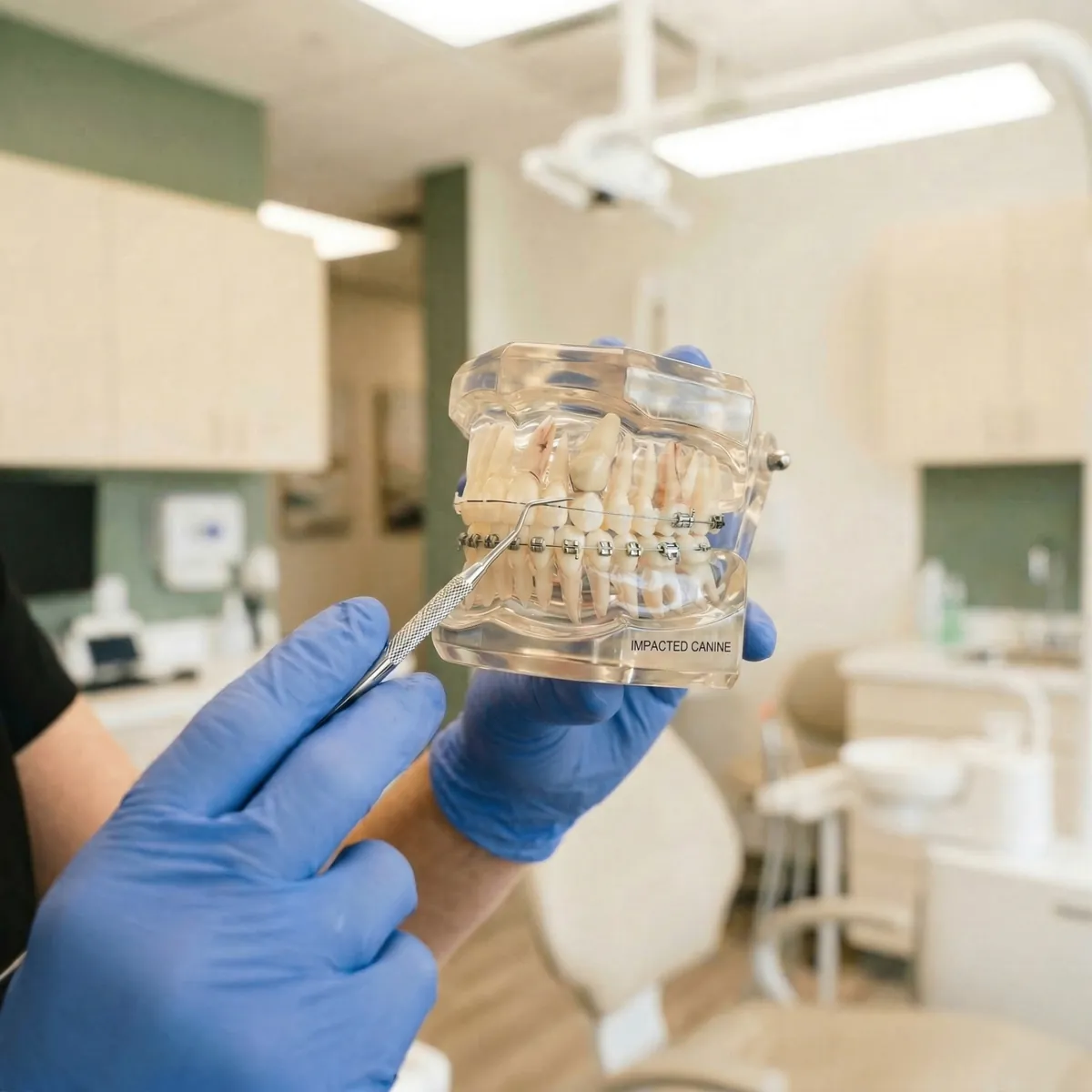
"An impacted tooth doesn't have to mean an extraction. At Cookeville Oral Surgery, we work closely with your orthodontist to expose and guide impacted teeth into their proper position, preserving your natural smile."
What Are Impacted Teeth?
An impacted tooth is one that is stuck and unable to erupt into its proper functional position. While wisdom teeth are the most commonly impacted, the upper canines (eyeteeth) are the second most frequently affected. These critical teeth play an essential role in your bite and smile.
The maxillary canines are the last front teeth to erupt, typically coming into place around age 13. They are among the strongest teeth with the longest roots, designed to be the first teeth that touch when your jaws close and to guide the rest of your teeth into proper alignment.
When a canine becomes impacted, every effort is made to help it erupt into its correct position rather than simply extracting it. Our oral surgeons use proven surgical techniques to expose and bracket impacted teeth, working with your orthodontist to achieve the best possible outcome.
Signs You May Have an Impacted Tooth
Missing Adult Tooth
An adult tooth that hasn't appeared by the expected age may be impacted beneath the gum.
Prolonged Baby Tooth
A baby tooth that remains well past the normal age of loss may be blocking an impacted permanent tooth.
Asymmetric Eruption
Teeth on one side have erupted but the corresponding tooth on the other side has not.
Swelling or Discomfort
Unusual swelling, tenderness, or pressure in the gums near an unerupted tooth.
X-Ray Detection
Many impacted teeth are discovered during routine dental X-rays or panoramic imaging.
Shifting of Adjacent Teeth
Nearby teeth may shift or become crowded due to pressure from an impacted tooth.
Treatment Approaches
Exposure & Bracketing
The most common treatment for impacted canines. The oral surgeon exposes the tooth and attaches an orthodontic bracket, allowing the orthodontist to gradually guide it into position.
Surgical Exposure Only
In some cases, simply removing the tissue covering the impacted tooth is enough to allow it to erupt naturally on its own.
Extraction of Obstacles
Removing over-retained baby teeth, extra teeth (supernumerary teeth), or growths that are blocking the impacted tooth's eruption path.
Extraction & Replacement
For patients over 40 or when the tooth is fused in place, extraction followed by a dental implant or fixed bridge may be the best option.
What to Expect
Your surgeon will perform a thorough examination including panoramic X-rays or 3D imaging to determine the exact position and angle of the impacted tooth.
Why Early Detection Matters
Age matters when it comes to treating impacted teeth. This is especially true for impacted canines, which play a key role in both your bite and your smile. The earlier an impacted tooth is detected, the more treatment options are available — which is one of many reasons routine dental exams and X-rays are so important.
Ages 10–11
Highest SuccessRemoving the primary canine and creating space with orthodontic treatment gives the permanent tooth the best chance to come in on its own. Research shows this approach is most effective before age 12.
Ages 13–19
Highly SuccessfulSpontaneous eruption is no longer expected, but a minor surgical procedure to uncover the tooth — combined with orthodontic traction — is highly successful. Young bone responds well to treatment.
Ages 20–29
EffectiveSurgical exposure with orthodontic traction remains effective throughout the twenties, with outcomes similar to younger patients. Treatment may take longer, but success rates are still favorable.
Ages 30–39
DecliningSuccess rates drop considerably after age 30. The risk of ankylosis (the tooth fusing to bone) increases, and treatment takes significantly longer. Each case requires careful evaluation.
Ages 40+
LimitedAnkylosis risk is high, often making guided eruption no longer viable. Depending on symptoms and the health of surrounding teeth, options include monitoring, extraction, or replacement with a dental implant or bridge.
Whatever your age, the best first step is a thorough evaluation. If your dentist has identified an impacted tooth, we encourage you to schedule a consultation so we can recommend the right approach for your specific situation.